Originally published on LinkedIn.
A friend of mine and his colleague (Gerard Pietrykiewicz, DTM & Achim Klor) published a post I read today about AI in HR. It was a good post, and it named something real. What struck me, though, is that the issue runs deeper than AI in recruiting.
We used to call it garbage in, garbage out, and that principle still holds, but AI is changing the character of the problem. The garbage is no longer just arriving at the system from careless human inputs. Increasingly, it is being generated upstream by AI itself, because judgment, vetting, and validation are being abdicated in the name of speed and efficiency. That is the part too many organizations still miss.
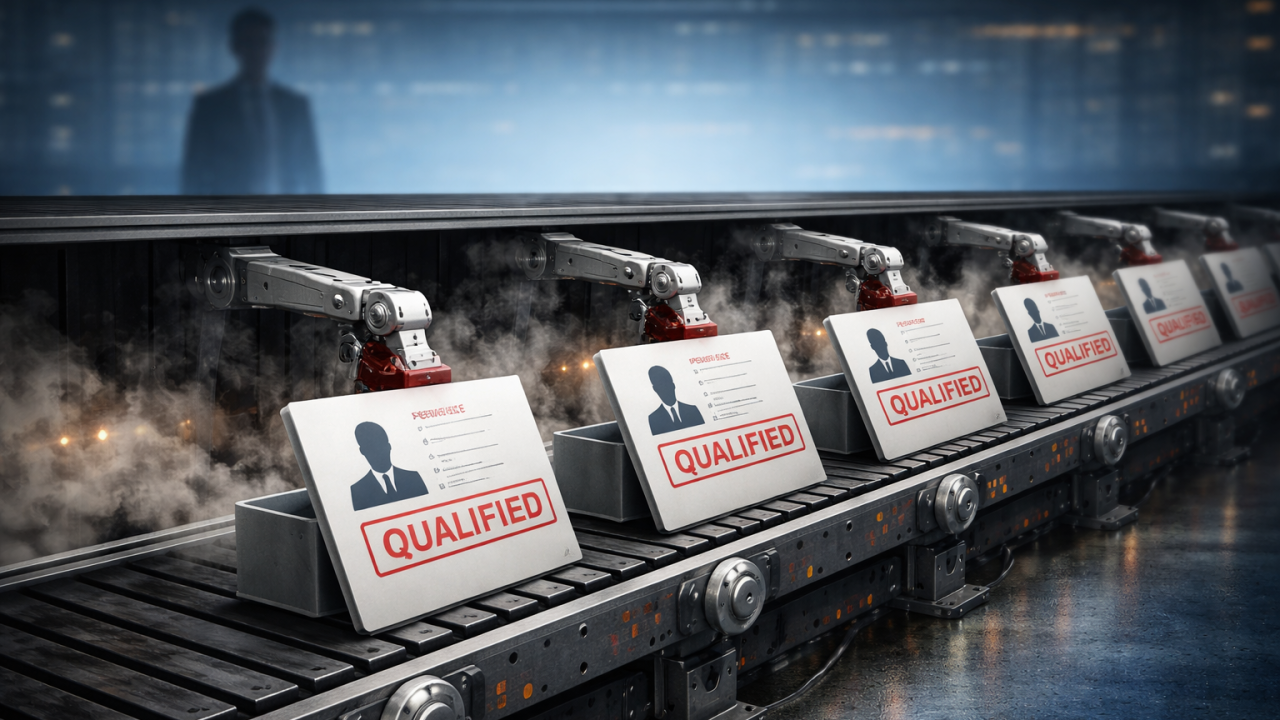
AI is not merely amplifying bad hiring processes; it is industrializing abdicated judgment.
In recruiting, that may show up as vague job descriptions, inflated requirements, algorithmically generated postings, and a flood of polished but low-signal applications that then need to be filtered by more AI. But hiring is only the visible edge of the problem. The deeper issue is organizational. Leaders are using AI not only to accelerate work, but in too many cases to avoid the harder human work that should precede automation in the first place.
What is the real purpose of the role? What value is actually being sought? What evidence would demonstrate a good fit? What distinctions matter, and which are noise? Those are judgment questions. They are not administrative details to be outsourced to a machine simply because a machine can produce something quickly.
This is one of the reasons I wrote recently that "When Awareness Is Not Enough". Recognizing that AI can help with efficiency is not the same thing as being ready to use it well. In fact, awareness without discipline can be dangerous, because it creates the illusion of progress while bypassing the actual thinking required for real progress. The organization feels like it is moving efficiently because artifacts are being produced, workflows are being accelerated, and outputs are arriving faster.
But speed applied to ambiguity does not create clarity; it scales confusion.
That is what makes this moment different. Bad process used to fail quietly; AI lets it fail at scale. And when it does, the failure is often misread. People blame the model, the tool, or the technology. Sometimes that is warranted, but often it is not. The technology did not invent the ambiguity. It exposed it, accelerated it, and then multiplied the consequences.
The real failure occurred earlier, at the point where leaders chose convenience disguised as efficiency over thought, automation over discernment, and output over understanding.
That is why I keep coming back to the same point: you cannot automate discernment you have not first built and understood.
AI can absolutely help with hiring, and a great many other things. It can reduce administrative drag, improve responsiveness, surface patterns, and support better decisions. But it cannot compensate for the absence of human clarity, or alignment to mission. It cannot define value where the organization has not done so itself. It cannot rescue leaders from the responsibility of discernment and judgment.
When those foundations are weak, AI does not fix the process; it hardens the weakness into system behavior, creating industrialized chaos and inefficiency.
This is not really an HR problem, and it's not limited to the HR domain alone. It is a leadership problem showing up in HR first. HR may be where the issue is easiest to see, but the underlying pattern is not unique to HR. It can emerge in strategy, transformation planning, procurement, customer operations, or anywhere organizations use AI to speed execution ahead of clear intent and defined standards.
That is why the conversation matters. Not because recruiting is broken, but because it reveals something broader about how organizations are approaching AI. Too many still treat it as a magic button substitute for thinking, rather than a capability that depends on human thinking and reasoning first. Until that changes, institutions will continue mistaking acceleration for improvement, and activity for effectiveness.
The real issue is not whether AI can accelerate the process, but what exactly it is being asked to accelerate. AI will not compensate for the absence of human engagement, clarity, and judgment. If purpose is vague, value is undefined, and discernment has already been abdicated, AI does not create a better outcome; it industrializes the failure at the push of a button, and then wraps it in the appearance of legitimacy.