Determining Truth from Advocacy: The New Challenge of PLM Leadership
There is no one tool to rule them all, and there shouldn't be.
That may sound obvious, but in the world of PLM, PDM, ERP, digital thread, and enterprise transformation, it is often left unspoken, and eventually forgotten. Many software vendors believe their platform offers the most coherent answer. Consulting firms often have a preferred method, playbook, or implementation pattern. Internal teams carry their own history, tribal knowledge, preferences, constraints, and political realities, and the customer has to make the best choice they can with biased, imperfect information and data, both internal and external.
The decision makers are then left trying to determine truth from advocacy. That is not an easy task in any sense. In fact, it may be one of the hardest leadership challenges in the modern enterprise technology landscape. The decision is not simply which platform to buy, which workflow to automate, which integration to build, or which function or domain is more or less dominant. The deeper question is where product meaning, lifecycle control, configuration authority, and decision confidence should live, so the enterprise can reliably deliver the value outcomes its customers depend on.
For many enterprises, the risk sits on both sides of the decision. On one side is platform dependency. A vendor platform can bring discipline, coherence, and speed. It can reduce local variation, simplify access to information, reduce process friction, and create a more consistent operating environment. But in long-lifecycle industries, a platform decision is not just a software decision. It can become a decades-long operating constraint.
The danger is not simply vendor lock-in. It is chosen dependency that becomes enterprise confinement. A platform may arrive with the promise of lifecycle coherence, and the vendor may sincerely believe the best answer is to manage the product lifecycle end to end inside its own ecosystem. But as product structures, data models, change logic, integration patterns, training, governance, reporting, and institutional memory become embedded over time, the platform begins to form its own evolving enterprise worldview. Over time, the enterprise may discover that it no longer simply uses the platform. It thinks through the platform.
On the other side is integration sprawl. In an effort to avoid being trapped by one vendor, organizations often preserve too many tools, too many local processes, and too many best-in-class exceptions. What begins as flexibility for value stream optimization becomes fragility. The enterprise avoids platform confinement, but loses architectural coherence.
This is where many digital thread efforts struggle. A digital thread is not necessarily created by connecting every system to every other system in a string of best-in-class tools. That can lead to an architecture hairball, not a thread. The real work is deciding which systems should be appropriately authoritative for which domains, which concepts must remain enterprise-governed, and which integration patterns are allowed.
Best-in-class tools still matter. They can create advantage at the edge, especially where specialized capability is truly required. But best-in-class thinking becomes dangerous when it fragments the product-truth core and becomes pervasive as a leading architecture principle. Configuration, change, effectivity, compliance evidence, lifecycle state, and decision traceability cannot be scattered across disconnected pockets of local optimization. That does not lend itself well to a system which should provide clear visibility and accountability throughout.
The better answer is not one platform, and it is not unlimited tool choice. It is intelligent authority design: deliberate, knowledge-based, and bounded by domain.
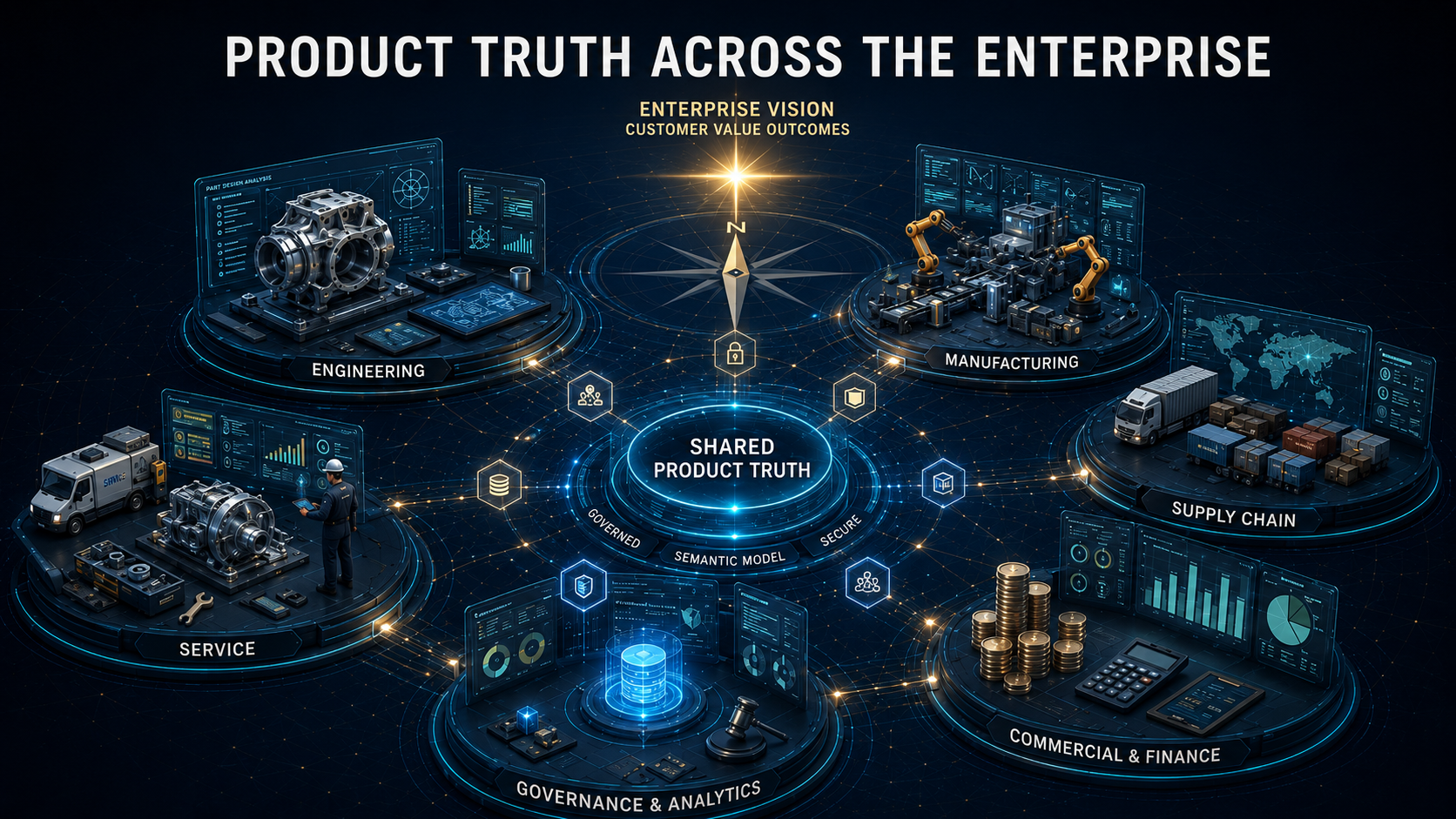
Engineering product definition may have one dominant system of record. Manufacturing may require a different authority for as-built reality. ERP may own commercial, financial, and execution truth. Service may own as-maintained configuration. Supplier collaboration may require its own controlled boundary. Even labour cost may cross boundaries, with HR, estimating, sales, finance, and delivery each shaping its part of the holistic truth. None of these domains should be allowed to invent their own version of the enterprise architecture, but none should be blindly collapsed into another platform’s model either. They are contributors to, and participants in, the broader enterprise model, not unilateral owners of it. They are necessarily interdependent, and they should be considered and cared for in that way.
This is the leadership challenge: govern the boundaries and the people within them. What is the enterprise vision? What outcomes matter most? What guiding principles will shape the decisions of the enterprise, consultants, and vendors alike?
A platform may own local engineering change without owning enterprise program change. A PLM system may govern design maturity without becoming the sole authority for cost, schedule, certification, production break-in, fleet applicability, or customer impact. An ERP system may own execution truth without being the right place to define engineering intent, but a necessary feedback loop between them needs to exist. A specialized tool may produce critical insight without becoming a semantic anchor for the enterprise. That distinction matters.
Too often, companies confuse a system of record with a system of authority. They are not always the same thing. A system may store the data, manage a workflow, or support a domain process, but the enterprise still needs to decide where meaning is governed and where decisions are made.
This is also where vendor myopia, or perhaps more fairly, platform worldview myopia, can become a problem. Vendors naturally advocate for the coherence of their own platform. From a vendor's perspective, the platform works best when the customer adopts the model fully. That is not irrational. But from the enterprise perspective, the concern is different: “Your platform is important, but it is not the only language our business must speak.” That concern is legitimate.
Modern enterprises do not need more disconnected tools. They also do not need to surrender product truth to a single platform worldview. They need architectures that are platform-aware but enterprise-sovereign. That means using platforms for what they are good at, while refusing to let any one of them become the only place where meaning exists.
The next era of PLM leadership will not be defined by choosing the winning platform. It will be defined by governing the boundaries between platforms so product truth remains usable, portable, and decision-relevant across the enterprise.
A key point in this equation is that the relevant information must be shared openly and truthfully. The enterprise’s value outcomes depend on it. If vendors, consultants, and internal stakeholders cannot engage in an honest discussion without defaulting to advocacy, defensiveness, or platform preference, the enterprise’s ability to create consistent, long-term value will remain at risk.
This is where the real work begins.