Most conversations about artificial intelligence begin with the technology. What model should we use? What platform should we deploy? What use cases can we automate? How quickly can we move from pilot to scale?
Those are reasonable questions, but in industrial environments they are not the first questions that matter. In aerospace, defense, advanced manufacturing, energy, infrastructure, and other complex operating environments, information is not just information. It carries ownership, contractual boundaries, intellectual property risk, export sensitivity, supplier obligations, quality implications, safety consequences, and long lifecycle accountability. It can also influence relationships, negotiations, performance assessments, design choices, quality interventions, compliance posture, and commercial outcomes.
Supplier performance is one example. The ability to learn more from data may create better visibility, but it may also expose weaknesses, shift leverage, complicate contract structures, or raise new questions about who had the right to derive, retain, share, or act on that intelligence in the first place.
The same issue extends into human and organizational performance. AI-enabled analysis may begin with process data, quality data, delivery data, engineering data, or program data, but the patterns it reveals can quickly implicate teams, functions, decision behaviours, leadership practices, and individual performance. That does not make the intelligence illegitimate, but it does make it sensitive. Organizations need to decide in advance how such insight may be interpreted, who is allowed to see it, how it may be acted upon, and how people are protected from crude or decontextualized conclusions.
In these environments, the question is not simply whether artificial intelligence can produce an answer. The question is whether the organization can trust the full business intelligence chain that produced the answer well enough to act on it, whether it validates, refines, expands, or changes the original question, and whether it is leading you to learn.
That chain begins before the model ever sees the data. It begins with the question: who is allowed to ask it, is it the right question, and is the organization prepared for what the answer may reveal?
This matters because artificial intelligence does not only accelerate analysis. It can expose assumptions, dependencies, weaknesses, patterns, behaviours, and risks that were previously hidden inside fragmented processes, disconnected systems, or organizational habits. The answer may be technically correct and still organizationally disruptive. It may reveal that the original question was too narrow, that the available data is insufficient, or that the decision the organization wanted to make is not supported by the evidence.
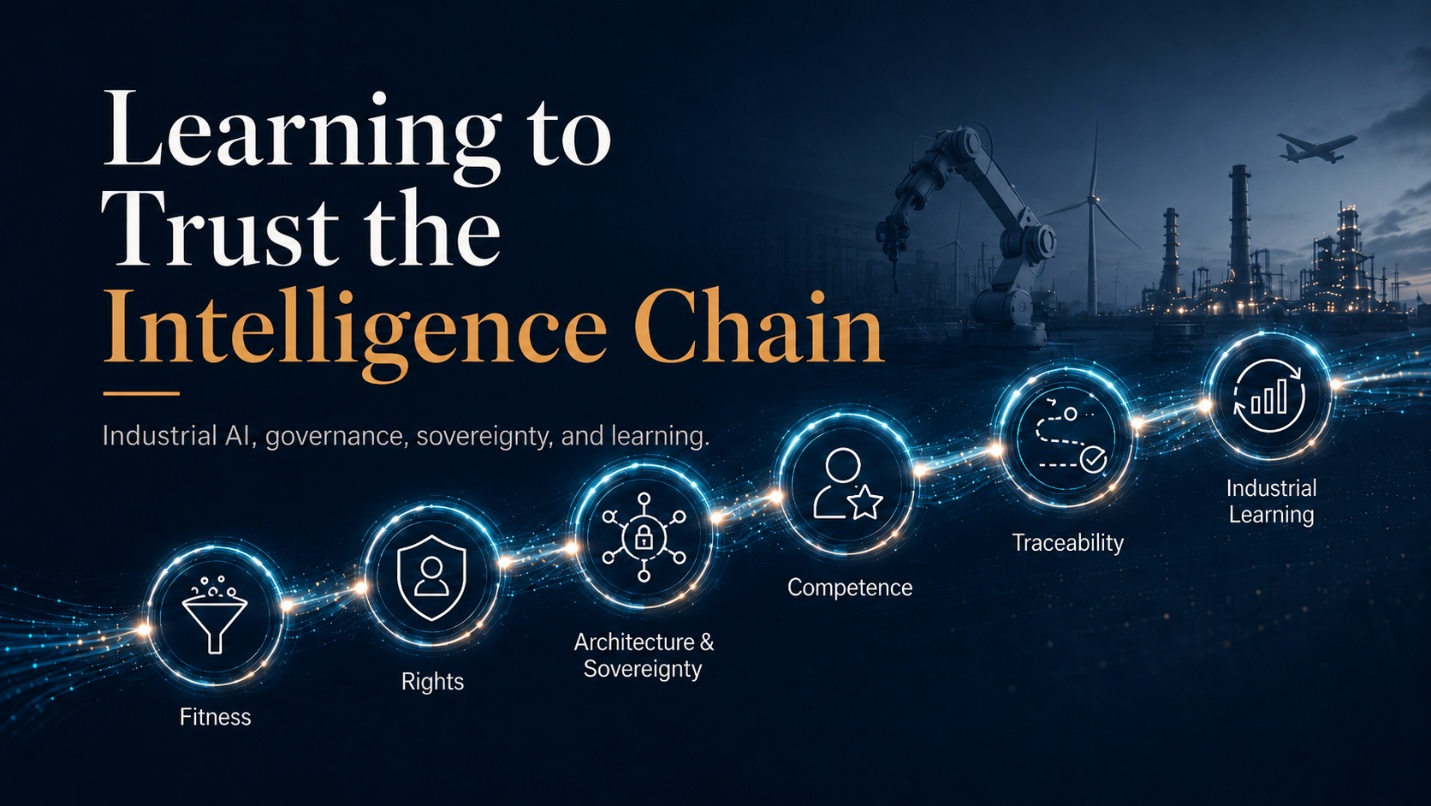
That is why industrial AI cannot be governed only as a technology deployment. It has to be governed as a business intelligence chain: the full path from question, data, rights, context, architecture, validation, and judgment through to action and learning. This is the chain AI augments.
Data fitness
The first link is data fitness. Not all data that is available is fit to answer the question being asked. Data may be accurate but incomplete. It may be current but contextually wrong. It may describe what happened, but not why it happened. It may represent one part of the lifecycle while being treated as if it represents the whole.
Before AI is trusted to reason over data, someone must be accountable for determining whether the data is the right kind of data to address the question. In industrial AI, organizations may need the equivalent of a data curator or librarian function: people who understand not only where data lives, but what it means, how it was created, what context it carries, why it is or should be relevant, and what conclusions it can or cannot legitimately support.
Rights and access
The second link is rights and access. Ownership is not the same as access. Access is not the same as authority to expose. Exposure is not the same as authority to act.
In a complex industrial network, data may involve internal engineering knowledge, supplier intellectual property, regulated information, customer commitments, quality records, certification evidence, contractual obligations, or sensitive performance signals. The fact that data can be technically connected does not mean it should be made available to every AI-enabled workflow.
Leaders need to know who owns the data, who has rights to it, who should have access to it, and under what conditions it may be used. They also need to know whether the people making those decisions understand the consequences of getting them wrong.
Architecture and sovereignty
The third link is architecture. It is not enough to say that data is encrypted in transit or protected between endpoints. Industrial AI architectures may externalize data into retrieval systems, orchestration layers, agents, application services, logs, caches, model interfaces, plugins, downstream tools, and human review points, some of which may sit outside the organization’s direct control. Each one can become a place where sensitive information is exposed, transformed, retained, inferred, misunderstood, or placed at risk in ways the originating organization may not fully see. The harder question is whether the data remains protected inside those systems after it leaves the organization’s perimeter, edge, or direct control.
The real architectural question is not simply, “Is the model secure?” It is: where does the data go, what touches it, what can see it, what can remember it, what can infer from it, and what controls remain intact after it reaches each system?
That is the heart of data sovereignty in an AI-enabled enterprise. Sovereignty is not only where the data resides. It is whether the organization can preserve control over meaning, movement, access, retention, inference, and use across the full lifecycle of the data. In practice, organizations need their own internal authority-to-operate logic for industrial AI: not a one-time technical approval, but an ongoing ability to see, verify, approve, and audit how information is managed, from provenance through use, with enough confidence to trust the decisions being made from it. This allows leadership to act as a critical and integral part of the process because they are able to inspect what they expect.
Competence governance
The fourth link is competence. One of the risks in today’s AI environment is that everyone suddenly has “AI” behind their name. Machine learning may have a long history, but industrial AI as an enterprise operating capability is still new. The ability to prompt a model, run a proof of concept, or speak fluently about automation does not automatically create the competence required to govern high-consequence information.
Leadership has to test the waters of capability carefully. The test is not whether people can speak fluently about AI; it is whether they can answer harder questions:
- Can the people responsible explain what data is fit for the question?
- Can they describe the exposure risks?
- Can they identify where lineage breaks?
- Can they distinguish between access, authority, and accountability?
- Can they explain what the model should not see?
- Can they tell leadership what the data cannot prove?
Policy and governance are critical, necessary elements for ensuring the right controls are in place. But this is not about constraining people into paralysis. Over-constraining AI, and indeed the people trying to use it responsibly within the appropriate policy structure, could inhibit or indeed, prevent discovery, learning, and value creation. Under-constraining it can create uncontrolled exposure, false confidence, and decisions that cannot be defended after the fact.
The challenge is to create enough constraint to protect the enterprise, while preserving enough freedom for capable people to learn, explore, and generate value responsibly.
Traceability
The fifth link is traceability. If AI influences a decision, the organization must be able to understand how that decision was shaped:
- What question was asked?
- What data was used?
- What data was excluded?
- What assumptions were present?
- What rights governed the data?
- What systems touched it?
- Who reviewed the output?
- Who had the authority to act?
Without that traceability, AI governance becomes theatre. A confident answer is not the same as a defensible one. In industrial environments, especially those connected to safety, quality, certification, supply chain performance, or long-term product lifecycle accountability, the organization must be able to explain not only what it decided, but how the intelligence behind the decision being made came to be trusted. That includes how newly revealed data or insight was verified, who validated it once identified, and whether it was reliable enough to influence action.
Learning from what becomes visible
The final link is learning. Industrial AI should not only help organizations get faster answers; it should help them ask better questions, understand when conditions have changed, and enable leadership to remain nimble enough to adapt or pivot when necessary.
This may be the most important point. Once AI reveals something meaningful, the trust chain itself may need to change. New intelligence may alter who needs access, what data is considered relevant, what risks have emerged, what competencies are required, and who has the authority to act.
The organization must be prepared to manage the knowledge it creates. If AI reveals a hidden pattern in supplier performance, for example, or a recurring quality issue, a lifecycle dependency, a team behaviour, or a risk embedded in the operating model, that new intelligence cannot simply become another unmanaged insight. In order to create value, it has to be deliberately surfaced, governed, contextualized, protected, and integrated back into the organization’s decision system. Properly handled, this intelligence can serve as both a risk mitigator and an opportunity generator, helping the organization improve capability, educate people, strengthen decision-making, and create more value from what it learns.
That is what separates AI experimentation from industrial intelligence.
The real leadership question is not, “Do we trust AI?” It is: can we trust the human, data, rights, architecture, competence, and accountability chain behind the answer well enough to act on it? And once we act, can we responsibly manage what we have learned?
Industrial AI will not be won by organizations that simply connect more data to more powerful models. It will be won by organizations that can govern the full lifecycle of intelligence: the question asked, the data used, the rights respected, the architecture trusted, the competence applied, the action taken, and the new knowledge created.
Done well, that governance does not slow the enterprise down. It gives leadership the confidence to learn, adapt, and enable informed change at pace in a dynamic world.
The harder challenge is not only being prepared to see the answer you asked for. It is being prepared to govern what that answer makes newly visible, what opportunities it creates, and where it may lead.